


Worms Zone .io - Hungry Snake
CASUAL AZUR GAMES
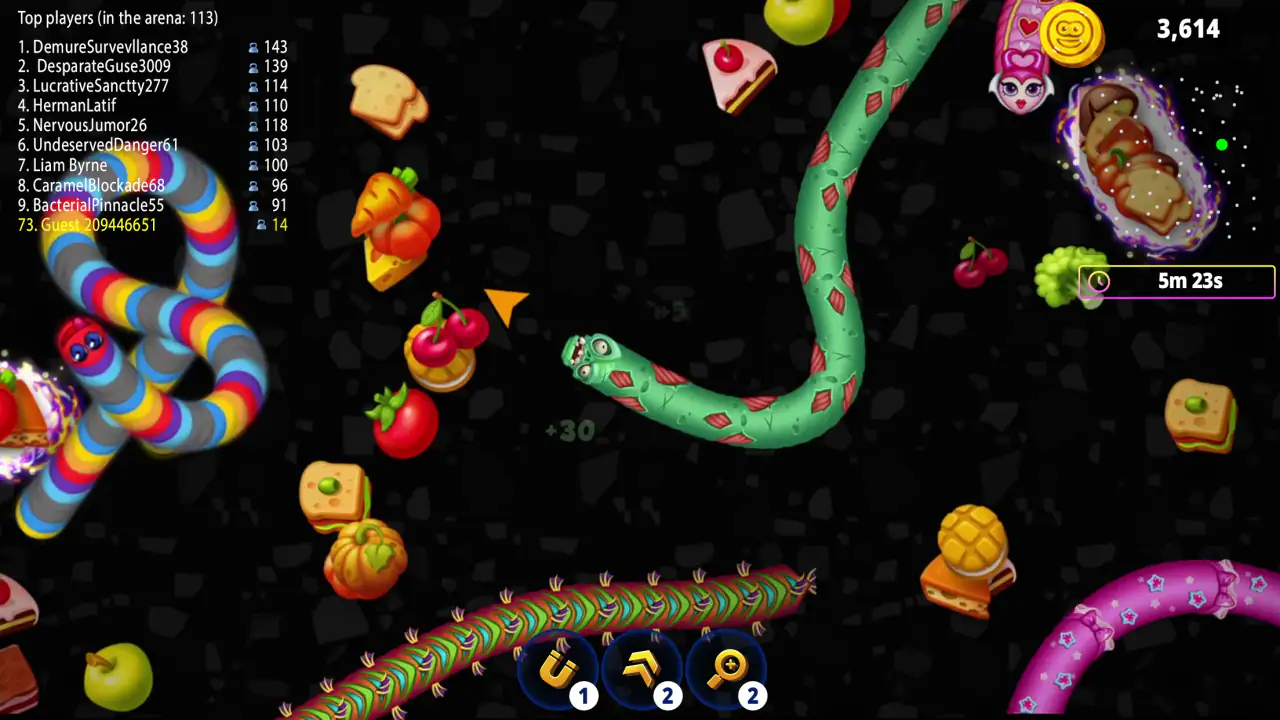
I picked up Worms Zone when I wanted a quick action game that worked well in short bursts, and it immediately made sense as a shared-device choice. One person can play for a few minutes, hand the phone over, and the next person understands the basic goal almost instantly: guide a growing worm, collect food, avoid dangerous collisions, and try to build a longer run than the previous player. It is simple enough for casual household use, but the movement becomes surprisingly tense once the arena fills with larger worms and tempting rewards.
This is a free action game from CASUAL AZUR GAMES, available for Everyone and listed at version 6.24.2. Its popularity is easy to understand: it has passed 500 million installs and holds a 4.3 average from around 3.2 million ratings. Those figures do not make it automatically perfect, but they do match my impression that this is designed for immediate play rather than a complicated commitment. I would recommend it to someone who wants an accessible snake-style game with a brighter, more active presentation than the classic versions.
How Worms Zone fits into a shared household
A game that works when the phone keeps changing hands
The strongest household use case is a short turn-based challenge, even though the game itself is not a formal pass-and-play board game. One person plays until the worm is defeated, then another person takes a turn and tries to beat the result. That arrangement works because there is very little explanation needed. You do not have to teach a complicated control scheme, remember a long story, or prepare a match before starting.
I found this especially useful during small gaps in the day: waiting for food, sitting together after dinner, or sharing one device while travelling. A younger player can focus on collecting nearby items and staying alive, while a more experienced player can attempt riskier routes around larger worms. The difference in skill becomes visible without making the game impossible for a beginner.
There is also a nice spectator element. When somebody has grown considerably, other people can watch the screen and react to near misses. That creates conversation without requiring everyone to own the game or play simultaneously. The downside is that the excitement can turn into back-seat coaching quickly. If several people are watching, it helps to agree that the current player gets to choose the route and that advice stays brief.
Related News

Why WhatsApp Messenger Still Makes Everyday Communication Feel Easy

Jurassic World: The Game Is the Better Dino Tycoon for Strategic Players

Threads in Real Life: Who Should Join, Lurk, or Leave

How SHEIN Turned Shopping Into an Endless Content Feed

How to Make Fortnite Feel Smarter on Mobile

Should You Switch to Microsoft Outlook on Mobile?
Why the simple objective still has depth
The basic idea resembles the familiar snake formula, but the live arena gives it more pressure than a slow grid-based version. Your worm is not simply following a fixed path through empty squares. You are constantly judging spacing, speed, nearby bodies, and whether a collection opportunity is worth the risk. A short run can feel relaxed, then become difficult because another worm cuts across the route you expected to use.
My most useful change in approach was to stop treating every visible reward as necessary. Early in a run, it is tempting to turn sharply toward anything nearby. That often creates more danger than progress. I had better results by keeping a broad escape route, collecting items that were already along my path, and only making a tight turn when the surrounding space was clear.
That is a practical lesson for shared play too. A new player may assume that the biggest worm wins by moving aggressively. In practice, patience matters more. Staying alive long enough to grow gives you more options than chasing every attractive item. The game teaches that naturally because careless movement ends a promising run very quickly.
Gallery
Taking turns without creating confusion
Because the game is built around individual runs, household coordination is mostly a matter of agreeing on whose turn it is and what counts as a record. I would avoid relying on memory if several people are playing. A simple note on paper or a quick screenshot of the result can prevent arguments, particularly when children are comparing attempts.
It is also worth deciding whether a player may restart immediately after a poor opening. If the group treats every attempt as a serious turn, the game feels more competitive. If the aim is simply entertainment, allowing a quick retry keeps frustration lower. The important point is that the app does not solve this social question for you; the household has to set its own rules.
On a shared phone, I would hand the device over only after the current run has clearly ended. Passing it during active movement is an easy way to cause an accidental collision. I also prefer keeping the screen orientation and control position consistent between turns, because a player who receives the phone at an awkward angle can lose before getting comfortable.
Setup, boundaries, and the everyday playing experience
What to expect before the first serious run
The appeal of this game is that setup is light. It is not the sort of title I would choose when I want to configure a profile, learn a large collection of systems, or spend time adjusting a strategy before playing. The main activity is available quickly, which makes it suitable for a child asking for a turn or an adult looking for a few minutes of distraction.
The store lists a minimum operating system of 10, so device compatibility is something I would check before planning to use an older phone or tablet. The game is free to download, with in-app purchases ranging from $0.49 to $104.99 per item. That range matters in a household, especially when a device is shared by children and adults. I would treat purchase approval as a separate household rule rather than assuming that free installation means every later action is free.
For a shared device, I would establish three boundaries before handing it over. First, the player should know whether purchases are allowed at all. Second, everyone should understand whether the goal is personal practice or a household high score. Third, the next player should receive the phone in the same general state, with no one changing settings or making decisions on another person’s behalf.
Managing attention rather than managing complexity
The bigger practical issue is not setup difficulty but attention. The action is easy to start, and that can make it easy to continue beyond the intended break. I have found that the game works better when I decide in advance whether I am playing one run, a fixed number of turns, or simply until a particular shared challenge is complete.
This is particularly useful with children. A clear stopping point is easier to follow than an open-ended instruction to stop soon. In a household setting, I would use the end of a run as the natural handover point and avoid promising that the next attempt will be the last unless everyone agrees. The game’s quick accessibility is a strength, but it also means there is little friction to prevent repeated retries.
Adults may want a similar boundary for themselves. The desire to improve a disappointing run is strong because each attempt feels short. That loop is enjoyable when it is intentional, but it can quietly replace a planned break with a much longer session. I see this as a limitation of the format rather than a defect in the controls.
Keeping the experience fair across ages
A mixed-age group will not begin on equal terms. Younger players may understand the objective immediately but struggle with judging distance and anticipating another worm’s path. Older players usually have an advantage in reading the arena and resisting unnecessary turns. I would not use a single score as the only measure of success if the group includes beginners.
Alternative household goals make the game friendlier. One player might focus on surviving longer, another on collecting efficiently, and another on making a careful run without chasing risky rewards. These goals still use the same action but reduce the feeling that a child has failed simply because an experienced player reached a larger size.
It also helps to explain that losing is not evidence that the controls are broken. The game is built around sudden danger, and even a careful run can end when the available space becomes crowded. That explanation is important for younger users, who may otherwise respond by moving faster and making the same mistake repeatedly.
Coordination, trust, and age-aware use
What adults should explain before sharing the device
The Everyone content rating makes the game an approachable option for a broad household audience, but an age label does not replace supervision or conversation. I would still show a child how the game works, explain that optional purchases can cost real money, and make it clear whose device is being used. Those are ordinary boundaries, yet they matter more when a game is easy to open and replay.
I would also explain that a shared device is not the same as a shared account. If several people use the same phone, they should not assume that another person’s progress, choices, or purchase decisions belong to them. The safest household habit is to ask before changing anything and to avoid treating the app as a place for private personal records unless the family has agreed on how those records are handled.
That distinction becomes important when an adult and child use the same device at different times. A child may see a tempting purchase or assume that a previous player’s result should be replaced. I prefer a simple rule: play the game, but ask before spending, changing, or deleting anything. It is a small amount of coordination that prevents most avoidable conflict.
When the game is a good choice for children
I can see this working well for children who enjoy immediate goals and visual action without needing a long explanation. The controls encourage hand-eye coordination, and the consequences of a risky move are easy to understand. A parent can sit nearby and talk through decisions such as leaving room to turn or waiting instead of chasing a reward.
It is less suitable as a quiet activity for a child who becomes upset by repeated failure or has difficulty stopping after a loss. The short-run structure encourages another attempt, and another attempt can feel urgent when a previous result was close to being improved. In that situation, a slower puzzle game or a turn-based title may be a better household option.
I would also be cautious about presenting the game as an educational tool. It can support discussion about planning, patience, and spatial awareness, but its main purpose is action entertainment. That is not a criticism; it simply sets a realistic expectation. Children are likely to enjoy it because it feels like a game, not because it disguises a lesson.
How it compares with familiar alternatives
Compared with a traditional snake game, this version feels more immediate and visually busy. Classic alternatives are often better when I want predictable grid movement, a calmer pace, or a purely score-based challenge. Worms Zone is the stronger choice when I want a more active arena where positioning around other worms creates the tension.
Compared with larger action games, it is much easier to share casually. There is no need to learn a long campaign before another person can try it, and a new player can understand the central task in moments. The trade-off is that it does not offer the same depth as a full action game with varied missions, character development, or a detailed story. If your household wants a long-term cooperative adventure, this is not a substitute.
It also differs from competitive multiplayer games that depend on coordinated teams. Here, the household challenge is usually informal: compare runs, watch each other, and exchange advice. That makes it less demanding to organize, but it also means players looking for structured teamwork may find the experience limited.
Three practical techniques that improved my play
My first useful technique was to treat the outer part of the arena as a reference rather than a permanent safe zone. Staying near an edge can simplify movement for a moment, but it can also reduce escape options when another worm approaches. I now use the edge to orient myself, then move inward only when I have enough space to turn away.
The second was to plan the exit before collecting anything that requires a sharp change of direction. If I cannot see where the worm will go immediately afterward, I usually leave the reward alone. This sounds conservative, but it prevents the common mistake of entering a crowded area without a route back out.
The third was to use observation as part of the turn. When watching somebody else play, I pay attention to how they react when the screen becomes crowded. That makes the next attempt more deliberate, especially for children who learn better by seeing a mistake than by hearing instructions. A shared device can therefore become a small coaching tool without turning the session into a lesson.
Who should play and who should skip it
Players likely to enjoy it
I would recommend Worms Zone to people who like quick action, visible progress during a run, and the satisfaction of improving through repeated attempts. It is a good fit for a household that wants an easy phone game everyone can understand, even if only one person plays at a time. It also suits players who enjoy making small tactical decisions under pressure rather than following a fixed level structure.
The free price lowers the barrier to trying it, and the Everyone rating makes it easier to consider for general family use. Its large audience, including more than 500 million installs, suggests that the basic format has broad appeal, while the 4.3 average from millions of ratings indicates that many players find the loop rewarding.
Players who may prefer something else
I would skip it if you want a calm game with no sudden losses, a carefully written story, or a clearly defined cooperative campaign. I would also look elsewhere if your main goal is a private, structured account for each household member. A shared-device arrangement can work, but it depends on the family’s own rules about turns, records, and spending.
Players who dislike in-app purchase prompts should also approach the free model thoughtfully. The listed purchase range extends from $0.49 to $104.99 per item, so adults should make sure the device’s purchase arrangements match the household’s expectations. The game can be enjoyed as a free download, but the presence of optional spending is still relevant when children use the same device.
Finally, people with older devices should check the operating-system requirement before making it part of a travel plan. The minimum listed OS is 10, and that may rule out some older hardware. For a household with several devices, I would test the intended phone or tablet first rather than assuming that every available screen will be suitable.
My household verdict after spending time with it
Worms Zone works because it turns a familiar idea into a lively, easy-to-share action loop. I like that a beginner can start quickly, while experienced players still have room to improve their judgement about routes, spacing, and risk. It is particularly effective as a one-device game for short household challenges, where people compare attempts and learn from one another.
Its limitations are just as clear. The repeated retry cycle can make stopping difficult, informal scorekeeping can create arguments, and the free model requires sensible purchase boundaries. It is not a replacement for a deeper action game or a cooperative title with formal teamwork. For a family that wants those things, another option will be more satisfying.
For everyone else, I think it is worth trying. I would install it for a shared phone, agree on turn-taking and spending rules, and start with a simple challenge such as making the safest run rather than chasing the largest result. That approach highlights what the game does best: quick action, easy coordination, and enough tactical pressure to keep a familiar snake concept interesting.
My recommendation is straightforward: choose it for casual household play and short competitive sessions, especially when different ages need a game they can understand quickly. Skip it when you need deep progression, formal family separation, or a calm experience with no pressure to try again.
FAQs for Worms Zone .io - Hungry Snake
What is the objective of Worms Zone .io - Hungry Snake?
In Worms Zone .io - Hungry Snake, the main objective is to grow your worm by consuming as much food as possible scattered throughout the arena. As your worm grows longer, you must avoid crashing into other players' worms while trying to make them collide with you to eliminate them and collect their mass.
Is Worms Zone .io - Hungry Snake free to play?
Yes, Worms Zone .io - Hungry Snake is free to download and play on both Android and iOS devices. However, the game contains in-app purchases that allow players to buy skins, boosters, and other cosmetic items to enhance their gaming experience.
How can I control my worm in the game?
Controlling your worm in Worms Zone is simple and intuitive. You guide your worm by tapping and holding on the screen in the direction you want it to move. Additionally, you can tap on the screen to make your worm speed up, which is useful for escaping tight spots or catching opponents.
Are there any strategies to succeed in Worms Zone .io?
Success in Worms Zone requires a mix of patience and strategy. Focus on collecting as much food as possible in the early stages to grow your worm. Use your worm’s length to encircle opponents, forcing them into collisions and collecting their mass. Stay on the move and avoid crowded areas to minimize risks.
Can I play Worms Zone .io - Hungry Snake offline?
Worms Zone .io - Hungry Snake is primarily an online multiplayer game, meaning you need an internet connection to play against other players. While there may be some offline features, the core experience and competition come from playing with others in real-time.
Pros
- Engaging and easy-to-learn gameplay.
- Vibrant and colorful graphics.
- Various skins and customization options.
- Regular updates with new features.
- Smooth performance with minimal lag.
Cons
- Can become repetitive over time.
- In-app purchases can be pricey.
- Ads can be intrusive during gameplay.
- Limited offline functionality.
- Requires continuous internet connection.


